Is It Wet Or Is It Cold?
How to approach responding to conflicting or overlapping signals…

How to approach responding to conflicting or overlapping signals…
A Lack Of Senses
Although we humans have significantly more than the five classical senses, we don’t come close to possessing all of the senses (nor the strength/sensitivity of the senses) which can be found in the animal or plant kingdoms.
We lack for example:
- Sonar (echolocation) found in bats and in some species of moths, which allows for prey/predator detection and aerial navigation by the use of ultrasonic sound.
- Infrared vision (visual heat sensing) found in pit vipers, which lets them detect body heat signatures against cooler backgrounds – creating thermal images of warm-blooded prey (like rodents) or predators, even in total darkness.
- Infrasonic sensing found in elephants, which allows them to communicate seismically over long distances, or detect impending storms, by feeling deep rumbles through the ground and air.
- Ultraviolet (UV) vision found in birds and bees, which allows them to forage and navigate by seeing UV patterns that are invisible to us; identifying and locating flowers that offer nectar and pollen.
- Magnetoreception (detection of magnetic fields) found in some birds, and in many sea creatures, which is used for navigation.
- Electroreception (detection of electrical fields) found in various species of fish, used for prey and predator detection.
- Chemical sensing found in plants, which allows for communication via volatile organic compounds.
– And, unlike many insects, we humans also lack hygroreceptors. So we can’t directly detect changes in humidity and moisture – which means that we’re unable to directly sense wetness.
We can only determine whether something is wet or not by analysing contextual clues captured by our other senses, for example:
- Look: Wet things are often more shiny (a wet road gives off more reflections, for instance), or you might see water droplets on the surface of an object, for example.
- Temperature: Wet things often get colder (which is why it can be so dangerous to get wet in the snow).
- Texture: Wet things might feel smoother or more wrinkly, depending on how they react to water.
- Friction: Wet things may become more slippery.
- Pressure: You can feel water running down your skin.
- Stiffness: Wet things are often not as stiff, e.g. a soggy piece of cardboard or wet clothing.
- Colour: Wet things might appear darker, for example a wet spot on your t-shirt.
- Weight: Wet things, such as a wet cloth, will typically be heavier than when dry.
You may have noticed your lack of a sense for wetness while for example air drying your laundry during winter:
– It’s easy to mistake laundry that’s just cold for still being wet (at first).
But by analysing further clues, your brain can determine if the laundry is, in fact, just cold.
Just like how you might mistake cold laundry for being wet, it’s easy to mistake or confuse other things in life as well.
Oftentimes, we misinterpret signals from our bodies or from our surroundings.
And because of that, in order to help solve an issue it’s hugely beneficial to first pinpoint and clarify its source.
Determine The Root Cause
Before we attempt to solve a problem, it helps to find out what the problem actually is and where it’s coming from.
Often, the first place to look for a cause is inwards.
If you’re having a bad morning, is it really because everyone and everything is being annoying, or difficult, or ‘against’ you?
– Or, could there instead be another reason? For instance:
- Are you tired? Poor sleep and little rest can make anyone grumpy or feel down.
- Are you hungry? ‘Hanger’ is a very real phenomenon.
- Are you stressed? Have you taken on too much responsibility?
- Are you distracted? Is there something that’s worrying you or weighing on your mind?
- Are you too hot or too cold? Feeling uncomfortable can manifest a bad mood.
- Are you overstimulated? Is there too much going on around you and you’re not taking enough breaks?
- Are you triggered (without good reason)? Was someone actually being negative or were you just in a bad mood and implied an ulterior meaning/motive where there was none?
- Are you irritated? Is there a stone in your shoe, or an equivalent to it?
- Are your surroundings messy? A chaotic environment can make it difficult to focus.
- Are you tense? Are you for example sitting in front of the computer all day with raised shoulders?
– Or, are there any other areas that you can identify, in which a small or reasonable change would drastically improve your current situation?
Of course, sometimes the source of a problem is indeed external, and you’ll have to deal with it appropriately.
But often, you just need to fix yourself first:
Meet Your Basic Needs
During the safety briefing before a flight, the flight attendants will usually say something along the lines of:
In the event of a loss in cabin pressure, oxygen masks will drop automatically from the panel above your seat. […] Please put on your own mask first, before helping others.
That last line is crucial.
In the event of an explosive decompression where the pressure loss is sudden and complete, at higher altitudes, the period of effective consciousness is measured in seconds before the effects of hypoxia start to take hold.
If you lose consciousness before you’re able to put on your own mask (but you got a mask on your five year old, for example), then your child or companion can’t help you.
By helping yourself first, you stay conscious and you are able to help others. But you’re no good to anyone else if you pass out.
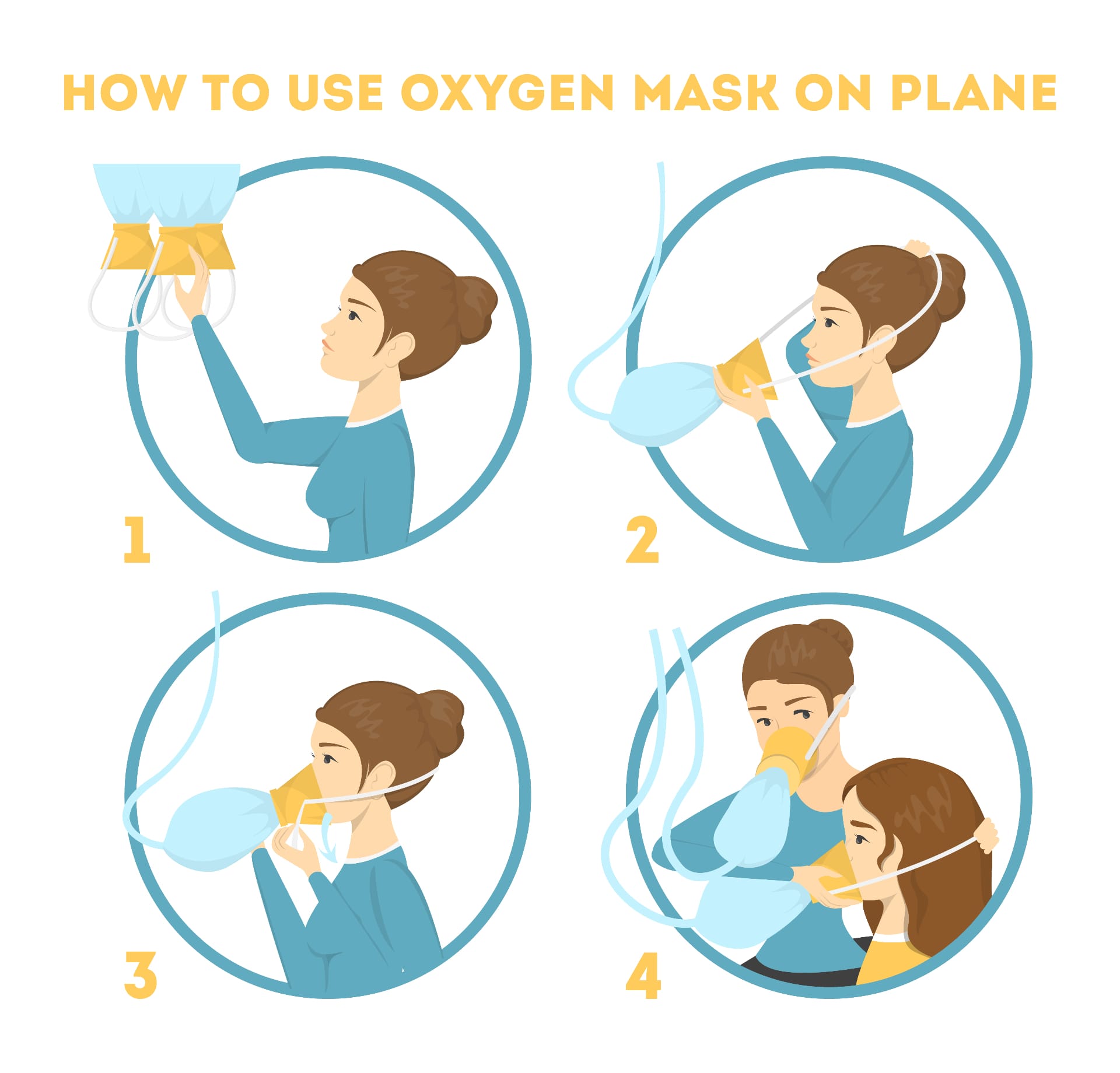
Put on your own oxygen mask first, before helping others.
In a (much less dramatic) sense, this applies to everyday life as well:
If you’re often hangry, stressed, tired, and in a bad mood, the people around you will suffer. By not taking care of yourself, you’re being unfair to them.
Looking after yourself first isn’t selfish, it’s critically important. By properly taking care of yourself, you can offer the best version of yourself – which is the best thing you can do for others.
Being present as a friend, family member, student, teacher – or whatever it may be – bringing good energy and vibes, and having a positive impact on the world is going to make a real and tangible difference.
And once you can confidently say that you have met your own basic needs – that you have genuinely done your part in improving your circumstances – you’ll typically find that everything isn’t as bad as you might initially have thought.
You’ll see the world around you through a clearer and more positive lens.
So, try to go bed at a reasonable time and get a good night's sleep, eat healthy food at regular times, get fresh air, see friends, get up and move/exercise, delegate work, take regular breaks, relax your shoulders, breathe, sing, dance, create – whatever helps you to become, and to maintain, the best version of yourself. So that you can give your best to others.
And, if in doubt, ask yourself the equivalent question to ‘is it wet or is it cold?’.
I hope you found this article useful. For more like this, see Advice.